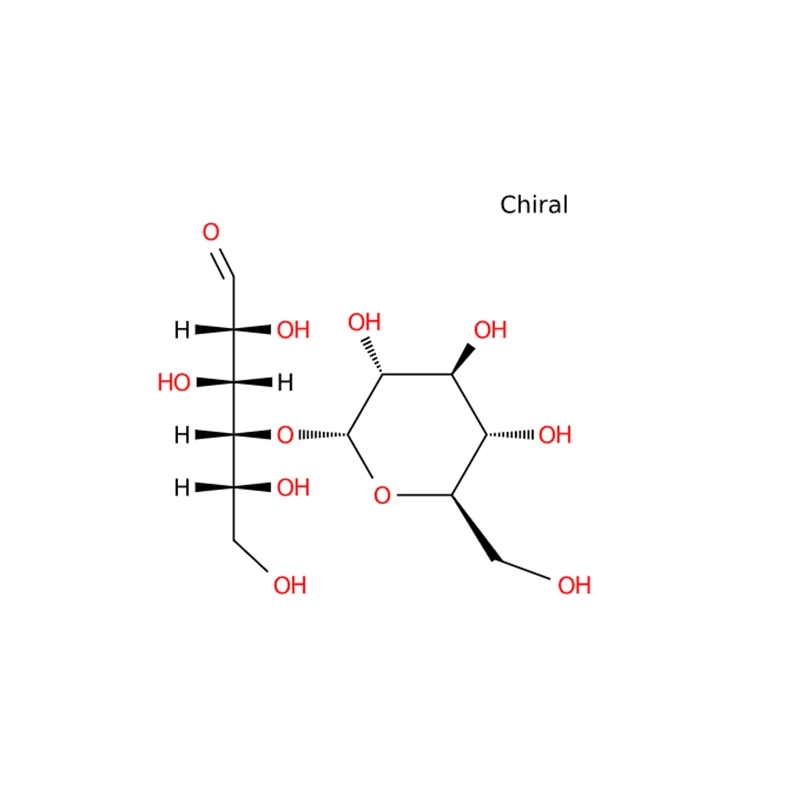
Product Description of Maltose CAS#69-79-4
Maltose, additionally named maltobiose or D-maltose, is a typical disaccharide compound. It is synthesized through the condensation and dehydration reaction of two α-D-glucose molecules, which are connected by α-1,4 glycosidic bonds.
Possessing a free hemiacetal hydroxyl group, maltose falls into the category of reducing sugars. Similar to glucose, it is capable of producing positive test results with Tollens’ (Doron’s) reagent and Fehling’s reagent.
The α-1,4 glycosidic bonding structure can further polymerize to form long-chain amylose substances, with the average molecular weight of amylose generally ranging between 20,000 and 200,000.

Maltose Chemical Properties
| Melting point | 110 °C |
| Boiling point | 397.76°C (rough estimate) |
| density | 1.54 |
| refractive index | n20/D 1.361 |
| storage temp. | 2-8°C |
| solubility | Very soluble in water; very slightly soluble in cold ethanol (95%); practically insoluble in ether. |
| pka | 12.39±0.20(Predicted) |
| PH | 4.0-6.5 (25℃) |
| Water Solubility | 310.3g/L(20 ºC) |
| λmax | λ: 260 nm Amax: 0.08 |
| λ: 280 nm Amax: 0.07 | |
| Merck | 135736 |
| BRN | 93798 |
| Stability: | Stable. Combustible. Incompatible with strong oxidizing agents. |
| LogP | -3.391 (est) |
| CAS DataBase Reference | 69-79-4(CAS DataBase Reference) |
| NIST Chemistry Reference | D-Glucose, 4-o-«alpha»-D-glucopyranosyl-(69-79-4) |
| EPA Substance Registry System | D-Glucose, 4-O-.alpha.-D-glucopyranosyl- (69-79-4) |

Product Application of Maltose CAS#69-79-4
Maltose is primarily applied for scientific research and laboratory analytical testing. Its molecular structure contains active aldehyde groups, endowing the compound with reducing characteristics and qualifying it as a typical reducing sugar.
In chemical experiments, maltose can react with Tollens’ reagent (ammoniacal silver solution) to generate a silver mirror reaction. It also produces brick red precipitates when reacting with freshly prepared alkaline copper hydroxide solution. Under suitable hydrolysis conditions, one maltose molecule can break down into two glucose molecules.
Furthermore, this substance serves as a key ingredient for biological culture media, a testing agent for polysulfide detection, and a reference standard for colorimetric analysis in analytical chemistry experiments.