

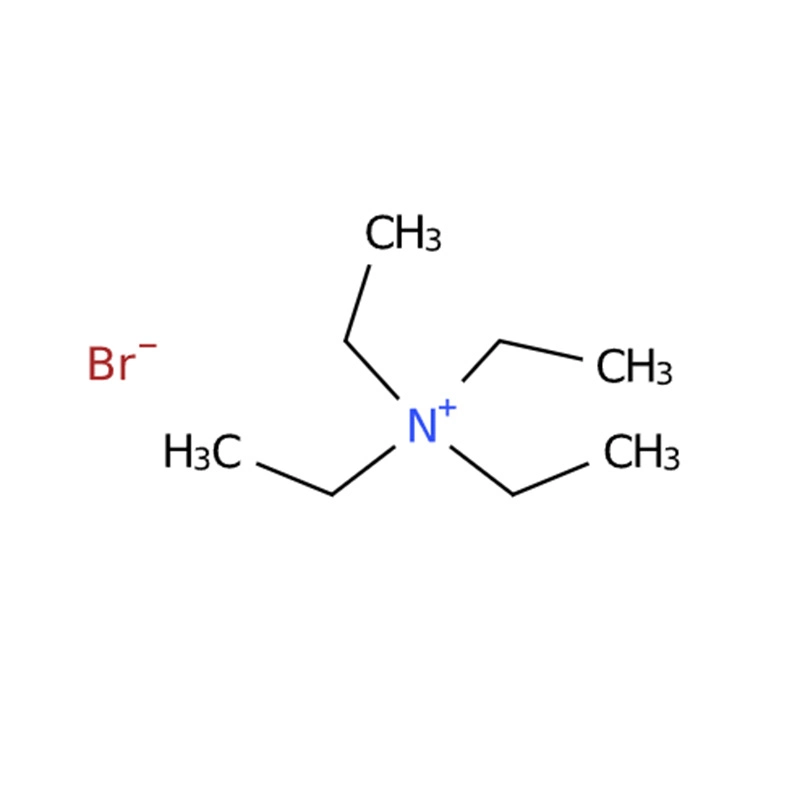
Product Description of Tetraethylammonium Bromide CAS#71-91-0
Tetraethylammonium bromide, also known as TEAB, is a quaternary-ammonium salt with molecular formula is C₈H₂₀BrN and molecular weight is 210.16. It appears as white crystalline solid and is distinctly hygroscopic. This compound exhibits extremely high water-solubility of 2795 g/L at 25℃, and dissolves readily in ethanol, chloroform and acetone, while being only sparingly soluble in benzene. Its 10% aqueous solution shows a pH value of about 6.5, and the pH property remains stable after heating at 95℃ for 28 hours.
It serves as a common phase transfer catalyst in organic synthesis, and also acts as an ionic liquid precursor, analytical reagent and electrochemistry research material.
Tetraethylammonium Bromide Chemical Properties
| Melting point | 285 °C (dec.)(lit.) |
| density | 1,397 g/cm3 |
| vapor density | 5.3 (vs air) |
| refractive index | 1,442-1,444 |
| storage temp. | Store below +30°C. |
| solubility | acetonitrile: 0.1 g/mL warm, clear, colorless |
| form | Solid |
| color | White to cream |
| Odor | Odorless |
| PH | 6.5 (100g/l, H2O, 20℃) |
| Water Solubility | 2795 g/L (25 º C) |
| Sensitive | Hygroscopic |
| Merck | 149199 |
| BRN | 3563430 |
| Stability: | Stable. Incompatible with strong oxidizing agents. |
| InChIKey | HWCKGOZZJDHMNC-UHFFFAOYSA-M |
| CAS DataBase Reference | 71-91-0(CAS DataBase Reference) |
| NIST Chemistry Reference | Tetraethylammonium bromide(71-91-0) |
| EPA Substance Registry System | Ethanaminium, N,N,N-triethyl-, bromide (71-91-0) |
| Hazard Codes | Xi |
| Risk Statements | 36/37/38 |
| Safety Statements | 26-36-37/39 |
| WGK Germany | 3 |
| RTECS | BS5950000 |
| TSCA | Yes |
| HS Code | 29239000 |

Product Application of Tetraethylammonium Bromide CAS#71-91-0
Tetraethylammonium bromide (TEAB) is a versatile quaternary ammonium salt with extensive industrial and laboratory applications. It serves as an efficient phase transfer catalyst for organic synthesis and a curing accelerator in polymerization reactions, effectively boosting reaction efficiency and product stability.
In electrochemistry and electronic research, it acts as an organic supporting electrolyte, and can be used as a structure-directing template for zeolite synthesis as well as a functional additive for oilfield chemical research. Additionally, it is widely applied as an ion-pair reagent for high-performance liquid chromatography analysis, surfactant compounding, and material preparation research. It can also be used in the formulation of adsorbents and laboratory-scale oil-displacing agents, covering diverse fine chemical and research scenarios.