
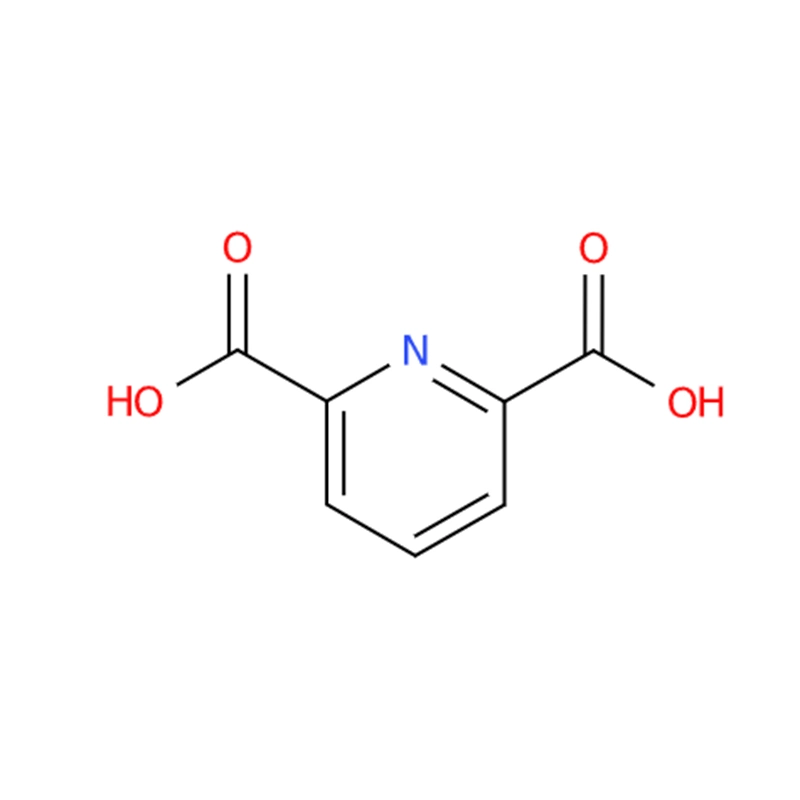
Products Description of Pyridine-2,6-dicarboxylic Acid CAS#499-83-2
Pyridine-2,6-dicarboxylic acid is a crucial fine chemical intermediate widely utilized in pharmaceutical synthesis and multiple industrial research fields. This compound naturally exists in bacterial spores, yet its natural abundance is extremely low. The low natural content makes large-scale extraction technically difficult and unable to meet the massive market and industrial production demands, so natural extraction cannot support commercial mass production and practical application scenarios.
The artificial synthetic route of pyridine-2,6-dicarboxylic acid was first reported in 1935. In this pioneering study, ALVIN W. Singer and S. M. McElvain from the University of Wisconsin adopted an aqueous potassium permanganate system as the oxidant to catalyze the oxidation reaction of 2,6-lutidine, successfully preparing the target compound with a yield of 64%. At present, the mainstream industrial manufacturing process of pyridine-2,6-dicarboxylic acid still relies on the oxidation reaction of 2,6-lutidine as the core synthetic route, which is mature and suitable for large-scale industrial production.
Pyridine-2,6-dicarboxylic Acid Chemical Properties
| Melting point | 248-250 °C (dec.)(lit.) |
| Boiling point | 295.67°C (rough estimate) |
| density | 1.5216 (rough estimate) |
| vapor pressure | <0.01 hPa (20 °C) |
| refractive index | 1.6280 (estimate) |
| Fp | 188 °C |
| storage temp. | Store below +30°C. |
| solubility | H2O: 1%, clear |
| pka | 2.16(at 25℃) |
| form | Crystalline Powder |
| color | White |
| PH | 2.0 (5g/l, H2O, 20℃) |
| Water Solubility | 5 g/L (20 ºC) |
| BRN | 131629 |
| InChIKey | WJJMNDUMQPNECX-UHFFFAOYSA-N |
| LogP | 0.3 at 25℃ and pH1.8 |
| CAS DataBase Reference | 499-83-2(CAS DataBase Reference) |
| NIST Chemistry Reference | 2,6-Pyridinedicarboxylic acid(499-83-2) |
| EPA Substance Registry System | 2,6-Pyridinedicarboxylic acid (499-83-2) |
| Hazard Codes | Xi |
| Risk Statements | 36/37/38-37/38-36 |
| Safety Statements | 26-36-24/25-37 |
| WGK Germany | 3 |
| Autoignition Temperature | 620 °C |
| TSCA | T |
| HazardClass | IRRITANT |
| HS Code | 29333999 |
| Toxicity | LD50 orally in Rabbit: 10500 mg/kg |
Product Application of Pyridine-2,6-dicarboxylic Acid CAS#499-83-2
Pyridine-2,6-dicarboxylic acid is a versatile heterocyclic intermediate with strong metal-chelating properties. In pharmaceutical research, it is used to synthesize enzyme inhibitors and anti-tumor lead compounds, and participates in biochemical studies targeting glutamate dehydrogenase.
As an organic ligand, it can coordinate with transition-metal and rare-earth ions to build MOF materials and industrial catalysts for gas adsorption and sensing. It also works as a chelating agent and analytical reagent in water-treatment and ion-detection fields. Furthermore, this compound is adopted for developing agrochemical products such as fungicides, supporting diversified fine-chemical and laboratory-synthesis requirements.