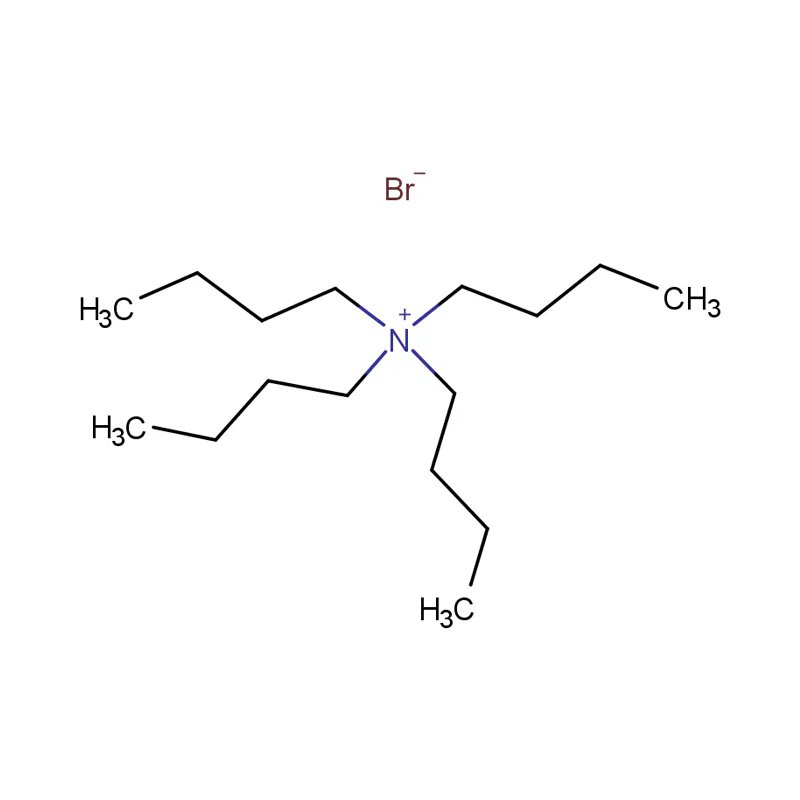
Product Description of Tetrabutylammonium Bromide CAS#1643-19-2
Tetrabutylammonium bromide, also known as TBAB, is a quaternary-ammonium salt with molecular formula C₁₆H₃₆BrN and molecular weight of 322.37. It appears as white crystalline powder at room temperature and is highly hygroscopic, requiring strict moisture-proof management. Its melting point ranges from 102-106℃, and it dissolves readily in water, alcohols and acetone, with limited solubility in benzene.
This ionic compound is a widely-used phase-transfer catalyst, which can improve the compatibility of aqueous-organic two-phase systems and accelerate heterogeneous organic reactions.
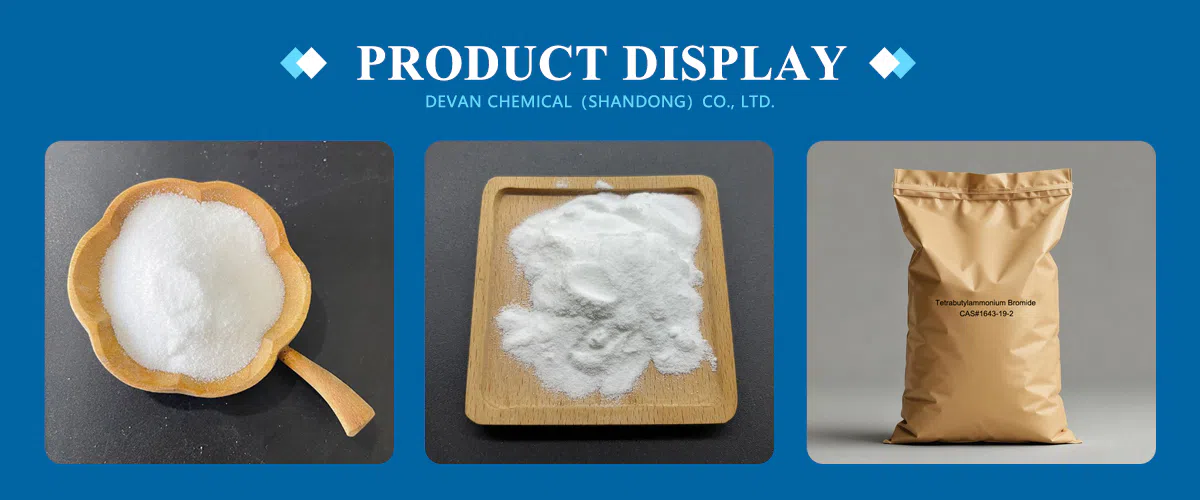
Tetrabutylammonium Bromide Chemical Properties
| Melting point | 102-106 °C(lit.) |
| Boiling point | 102 °C |
| density | 1.039 g/mL at 25 °C |
| vapor pressure | 0Pa at 25℃ |
| refractive index | n20/D 1.422 |
| Fp | 100℃ |
| storage temp. | Store below +30°C. |
| solubility | H2O: 0.1 g/mL, clear, colorless |
| pka | 0[at 20 ℃] |
| form | Crystalline Powder |
| Specific Gravity | 1.007 |
| color | White to slightly cream |
| Odor | Amine like |
| PH | 3.5 to 7.0 (50 g/L, 25 ℃) |
| Water Solubility | 600 g/L (20 ºC) |
| Sensitive | Hygroscopic |
| λmax | λ: 240 nm Amax: 0.04 |
| λ: 250 nm Amax: 0.03 | |
| λ: 260 nm Amax: 0.02 | |
| λ: 500 nm Amax: 0.02 | |
| BRN | 3570983 |
| Stability: | Stable. Incompatible with strong oxidizing agents. Protect from moisture. |
| InChIKey | JRMUNVKIHCOMHV-UHFFFAOYSA-M |
| LogP | 0.839 at 25℃ |
| CAS DataBase Reference | 1643-19-2(CAS DataBase Reference) |
| NIST Chemistry Reference | Tetra-N-butylammonium bromide(1643-19-2) |
| EPA Substance Registry System | Tetrabutylammonium bromide (1643-19-2) |
| Hazard Codes | Xi,Xn |
| Risk Statements | 36/37/38-22 |
| Safety Statements | 26-36-37/39 |
| WGK Germany | 3 |
| F | 3 |
| Hazard Note | Irritant |
| TSCA | Yes |
| HS Code | 29239000 |

Product Application of Tetrabutylammonium Bromide CAS#1643-19-2
Tetrabutylammonium bromide (TBAB) is a highly efficient phase-transfer catalyst widely used in biphasic organic synthesis reactions. It accelerates the synthesis of various fine chemical intermediates including ethyl cinnamate and pseudoionone, boosting reaction efficiency and product yield. This quaternary ammonium reagent is commonly utilized in laboratory research for developing anti-infective and anti-diabetic pharmaceutical molecules.
Moreover, it acts as an ion-pair reagent for chromatographic analysis. It can be applied in the research and preparation of pharmaceutical active ingredients, suitable for laboratory trials and industrial pilot production of specialty chemicals.