
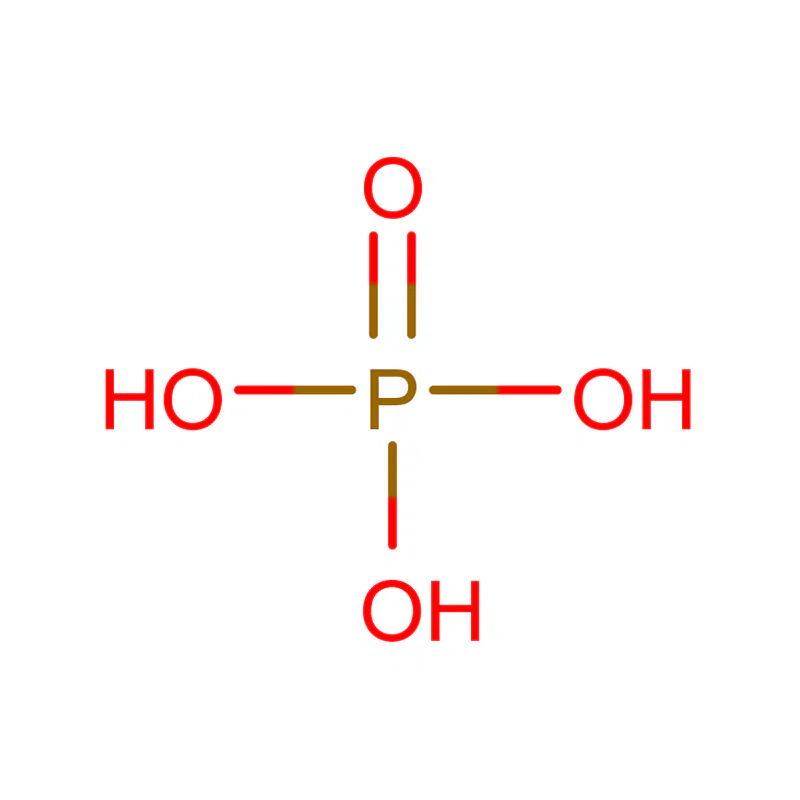
Product Description of Phosphoric Acid CAS# 7664-38-2
Phosphoric acid, also commonly referred to as orthophosphoric acid,with the molecular formula H₃PO₄, occurs as an odorless substance featuring a sharp sour taste, which can exist in the form of colorless transparent viscous liquid or orthorhombic crystalline solid. Its 85-percent aqueous formulation presents as a colorless or faintly tinted viscous liquid. This chemical bears a melting point of 42.35 °C and a high boiling point, and is completely miscible with water. When heated to 213 °C, it loses half of its bound water and transforms into pyrophosphoric acid; further heating up to 300 °C will convert it into metaphosphoric acid. It is readily soluble in both water and ethanol.
As a medium-strength inorganic acid, phosphoric acid is less acidic than potent mineral acids including sulfuric acid, hydrochloric acid and nitric acid, yet exhibits stronger acidity compared with weak acids such as acetic acid, boric acid and carbonic acid. It can generate diverse acid salts through reactions with sodium carbonate under different pH environments.
This compound poses irritant effects on human skin, potentially triggering inflammation and tissue injury. Heated concentrated phosphoric acid is capable of corroding porcelain materials. Owing to its hygroscopic property, sealed packaging is required for proper storage. The commercial-grade product is commonly supplied as an 82% viscous liquid, whose high viscosity originates from hydrogen-bond interactions within the solution system.
Phosphoric Acid Chemical Properties
| Melting point | ~40 °C(lit.) |
| Boiling point | 158 °C(lit.) |
| density | 1.685 g/mL at 25 °C(lit.) |
| vapor density | 3.4 (vs air) |
| vapor pressure | 2.2 mm Hg ( 20 °C) |
| refractive index | n20/D 1.433 |
| FEMA | 2900 | PHOSPHORIC ACID |
| storage temp. | no restrictions. |
| solubility | H2O: soluble |
| pka | 2.1-7.2-12.3(at 25℃) |
| form | Solid or Viscous Liquid |
| Specific Gravity | 1.7 |
| color | ≤10(APHA) |
| PH | 3.06(1 mM solution);2.26(10 mM solution);1.63(100 mM solution); |
| Odor | Odorless |
| PH Range | 1.5 |
| Water Solubility | MISCIBLE |
| λmax | λ: 260 nm Amax: ≤0.05 |
| λ: 280 nm Amax: ≤0.04 | |
| Merck | 147344 |
| BRN | 1921286 |
| Exposure limits | TLV-TWA 1 mg/m3 (ACGIH, MSHA, and OSHA); TLV-STEL 3 mg/m3 (ACGIH). |
| Dielectric constant | 61 |
| InChIKey | NBIIXXVUZAFLBC-UHFFFAOYSA-N |
| LogP | -2.15 |
| CAS DataBase Reference | 7664-38-2(CAS DataBase Reference) |
| NIST Chemistry Reference | Phosphoric acid(7664-38-2) |
| EPA Substance Registry System | Phosphoric acid (7664-38-2) |
Safety Information
| Hazard Codes | C,Xn,T,F |
| Risk Statements | 34-35-22-39/23/24/25-36/38-23/24/25-11 |
| Safety Statements | 7-16-26-36/37-45-36/37/39-1/2-24/25 |
| RIDADR | UN 3453 8/PG 3 |
| WGK Germany | 3 |
| RTECS | TB6300000 |
| F | 46091 |
| TSCA | Yes |
| HS Code | 2809 20 00 |
| HazardClass | 8 |
| PackingGroup | III |
| Hazardous Substances Data | 7664-38-2(Hazardous Substances Data) |
| Toxicity | ADI 0 to 70 mg / kg (total phosphate content in terms of phosphorus, FAO / WHO, 2001). |
| GRAS (FDA, § 182.1073, 2000). | |
| LD501530mg / kg (rat, oral). | |
| In case of daily intake of 2 ~ 4 g, it can cause mild diarrhea. The amount of sour agent used as a cola drink is 0.02% to 0.06%. | |
| IDLA | 1,000 mg/m3 |
Product Application of Phosphoric Acid CAS# 7664-38-2
Wet-process phosphoric acid mainly contributes to the manufacturing of multiple phosphate derivatives, among which are ammonium phosphate, potassium dihydrogen phosphate, disodium hydrogen phosphate, trisodium phosphate, as well as condensed phosphates. Refined-grade phosphoric acid is utilized for synthesizing calcium hydrogen phosphate intended for animal feed applications.
It finds broad applications within metal-processing workflows, covering metal-surface phosphating treatment and the formulation of electrolytic and chemical polishing liquids dedicated to aluminum articles. Within the pharmaceutical sector, it participates in the synthesis of sodium glycerophosphate, iron phosphate and zinc phosphate, the latter of which can act as dental filling binders.
Phosphoric acid can function as a catalyst for phenolic resin polycondensation reactions and serve as a drying agent for dyes and their synthetic intermediates. For printing operations, it helps prepare cleaning agents for offset color printing plates. It is also incorporated into soaking solutions for matchsticks. In metallurgical processes, it is adopted to fabricate phosphoric-acid-based refractory mud, which helps prolong the service cycle of steel-making furnaces.
Beyond the above-mentioned uses, it works as a coagulating agent for rubber slurries, a feedstock for inorganic adhesive production, and an anti-rust additive for metals in coating-related industries.