
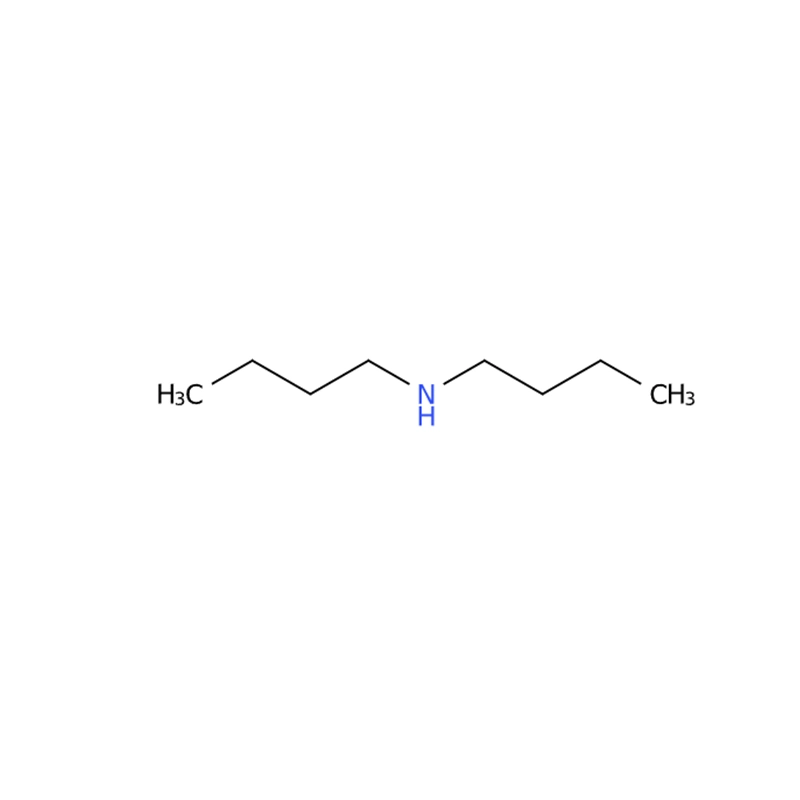
Products Description of Dibutylamine CAS#111-92-2
Dibutylamine, also known as N-butyl-1-butanamine or DBA, is a secondary aliphatic amine with a molecular formula of C8H19N and a molecular weight of 129.25. It appears as a colorless transparent liquid with a characteristic amine odor, having a boiling point of approximately 159 degrees C, a melting point of about -62 degrees C . The product is slightly soluble in water and readily miscible with ethanol, ether and most organic solvents.
As a reactive organic base, dibutylamine is widely used as a corrosion inhibitor in boiler water and metalworking fluids, a rubber vulcanization accelerator intermediate, and a building block for pharmaceuticals, agrochemicals, surfactants, emulsifiers and ore flotation agents. It is classified as a flammable and corrosive liquid and should be handled with proper protective equipment.
Dibutylamine Chemical Properties
| Melting point | −62 °C(lit.) |
| Boiling point | 159 °C(lit.) |
| density | 0.767 g/mL at 25 °C(lit.) |
| vapor density | 4.46 (vs air) |
| vapor pressure | 1.9 mm Hg ( 20 °C) |
| refractive index | n20/D 1.417(lit.) |
| Fp | 106 °F |
| storage temp. | Store below +30°C. |
| solubility | water: soluble3.8g/L at 20°C |
| pka | 11.25(at 21℃) |
| form | Liquid |
| color | White |
| PH | 11.1 (1g/l, H2O, 20℃) |
| Odor | Weak ammonia. |
| explosive limit | 0.6-6.8%(V) |
| Water Solubility | 4.05 g/L (25 ºC) |
| Merck | 143032 |
| BRN | 506001 |
| Dielectric constant | 3.0(20℃) |
| Stability: | Stable. Combustible. Incompatible with strong oxidizing agents, most common metals, strong acids. Vapours may flow over surfaces to a distant source of ignition. Can form explosive mixtures with air. |
| InChIKey | JQVDAXLFBXTEQA-UHFFFAOYSA-N |
| LogP | 2.1 at 23℃ |
| CAS DataBase Reference | 111-92-2(CAS DataBase Reference) |
| NIST Chemistry Reference | 1-Butanamine, N-butyl-(111-92-2) |
| EPA Substance Registry System | Dibutylamine (111-92-2) |
Safety Information
| Hazard Codes | Xn,T |
| Risk Statements | 10-20/21/22-35-23-21/22 |
| Safety Statements | 45-36/37/39-28A-26-23 |
| RIDADR | UN 2248 8/PG 2 |
| WGK Germany | 1 |
| RTECS | HR7780000 |
| F | 10 |
| Autoignition Temperature | 594 °F |
| TSCA | Yes |
| HS Code | 2921 19 99 |
| HazardClass | 8 |
| PackingGroup | II |
| Hazardous Substances Data | 111-92-2(Hazardous Substances Data) |
| Toxicity | LD50 orally in rats: 550 mg/kg (Smyth) |
Product Application of Dibutylamine CAS#111-92-2
This amine compound mainly contributes to manufacturing dithiocarbamate-based rubber accelerators. Sodium dibutyl dithiocarbamate (Accelerator TP) can be synthesized when dibutylamine reacts with carbon disulfide and sodium hydroxide. Subsequent reaction between Accelerator TP and zinc chloride yields zinc dibutyl dithiocarbamate known as Accelerator-BZ. These ultra-fast curing additives feature brief scorch duration and suit latex manufacturing workflows well. When combined with nickel sulfate, Accelerator TP yields ageing-resistant agent NBC. The ingredient shields natural rubber, styrene-butadiene rubber and chloroprene rubber from thermal damage, ozone erosion and outdoor weathering ageing.
Metal-based dibutyl dithiocarbamate derivatives including molybdenum, lead and antimony variants serve as engine-oil additives delivering anti-oxidation, anti-abrasion and extreme-pressure resistance. Moreover, Accelerator TP undergoes oxidation with potassium ferricyanide under zero-degree-Celsius surroundings to obtain tetrabutylthiuram disulfide, which acts as both rapid accelerator and vulcanizing reagent for all types of synthetic and natural rubber.