
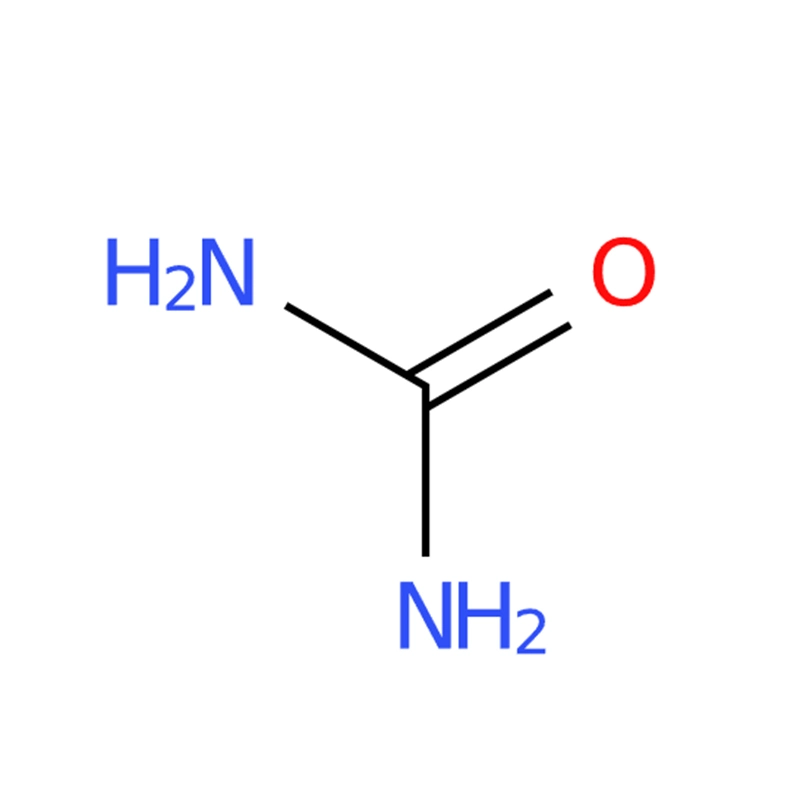
Products Description of Urea CAS#57-13-6
When the temperature stays below 20°C and relative humidity remains under 70%, urea exhibits no moisture absorption; it may even release water, leading to a drop in its moisture content. Once the temperature rises above 20°C and relative humidity exceeds 80%, urea starts absorbing moisture and can turn into a pasty mass under extreme circumstances. When ambient humidity subsequently declines, caking will recur. Its caking tendency is second only to ammonium nitrate.
Aqueous urea solution hydrolyzes and decomposes at 80°C to generate ammonium carbamate, ammonia and carbon dioxide. Heating accelerates the decomposition rate under both acidic and alkaline environments.
Urea easily reacts with linear carbohydrates to form crystalline adducts. It is capable of forming multiple complex salts with inorganic compounds, including Ca(NO₃)₂·4CO(NH₂)₂, NH₄Cl·CO(NH₂)₂, CaSO₄·4CO(NH₂)₂, MgSO₄·4CO(NH₂)₂·3H₂O and Mg(NO₃)₂·4CO(NH₂)₂·2H₂O. Moreover, it reacts with monocalcium phosphate to yield urea phosphate, dicalcium phosphate and water, following the reaction equation: Ca(H₂PO₄)₂·H₂O + CO(NH₂)₂ → H₃PO₄·CO(NH₂)₂ + CaHPO₄ + H₂O. Urea can also combine with nitric acid to produce urea nitrate: CO(NH₂)₂ + HNO₃ → CO(NH₂)₂·HNO₃. Additionally, it undergoes condensation with formaldehyde to form urea-formaldehyde derivatives. A high formaldehyde proportion facilitates the synthesis of urea resins, whereas a lower proportion generates slow-release urea.
Urea Chemical Properties
Melting point | 132-135 °C(lit.) |
Boiling point | 332.48°C (estimate) |
density | 1.335 g/mL at 25 °C(lit.) |
vapor pressure | <0.1 hPa (20 °C) |
refractive index | n20/D 1.40 |
storage temp. | 2-8°C |
solubility | H2O: 8 M at 20 °C |
form | powder |
pka | 0.10(at 25℃) |
color | white |
Specific Gravity | 1.335 |
PH | 8.0-10.0 (20℃, 8M in H2O) |
Odor | almost odorless |
Water Solubility | 1080 g/L (20 ºC) |
λmax | λ: 260 nm Amax: 0.03 |
λ: 280 nm Amax: 0.02 | |
Merck | 149867 |
BRN | 635724 |
Dielectric constant | 3.5(Ambient) |
Stability: | Substances to be avoided include strong oxidizing agents. Protect from moisture. |
InChIKey | XSQUKJJJFZCRTK-UHFFFAOYSA-N |
LogP | -1.660 (est) |
CAS DataBase Reference | 57-13-6(CAS DataBase Reference) |
NIST Chemistry Reference | Urea(57-13-6) |
EPA Substance Registry System | Urea (57-13-6) |
Safety Information
Hazard Codes | Xn,Xi |
Risk Statements | 36/37/38-40-38 |
Safety Statements | 26-36-24/25-37 |
RIDADR | Not regulated |
WGK Germany | 1 |
RTECS | YR6250000 |
TSCA | Yes |
HS Code | 31021010 |
Hazardous Substances Data | 57-13-6(Hazardous Substances Data) |
Toxicity | LD50 orally in Rabbit: 8471 mg/kg LD50 dermal Rat 8200 mg/kg |
Product Application of Urea CAS# 57-13-6
Urea finds its major application as an agricultural fertilizer. For industrial purposes, it acts as a key feedstock to manufacture urea-formaldehyde resins, polyurethane and melamine-formaldehyde resins. It also has extensive applications across pharmaceuticals, explosives, leather treatment, flotation reagents, pigments and petroleum dewaxing processes.When heated to approximately 200°C, urea converts into solid cyanuric acid. Derivatives of cyanuric acid cover trichloroisocyanuric acid, sodium dichloroisocyanurate, tris(2-hydroxyethyl) isocyanurate, triallyl isocyanurate, tris(3,5-di-tert-butyl-4-hydroxybenzyl) isocyanurate, triglycidyl isocyanurate, as well as cyanuric acid-melamine complexes. These derivatives possess wide-ranging and valuable uses. Specifically, trichloroisocyanuric acid and sodium dichloroisocyanurate are premium disinfectants and bleaching agents, and the worldwide production capacity of trichloroisocyanuric acid surpasses 80,000 tons.