Product Description of p-Xylene CAS#106-42-3
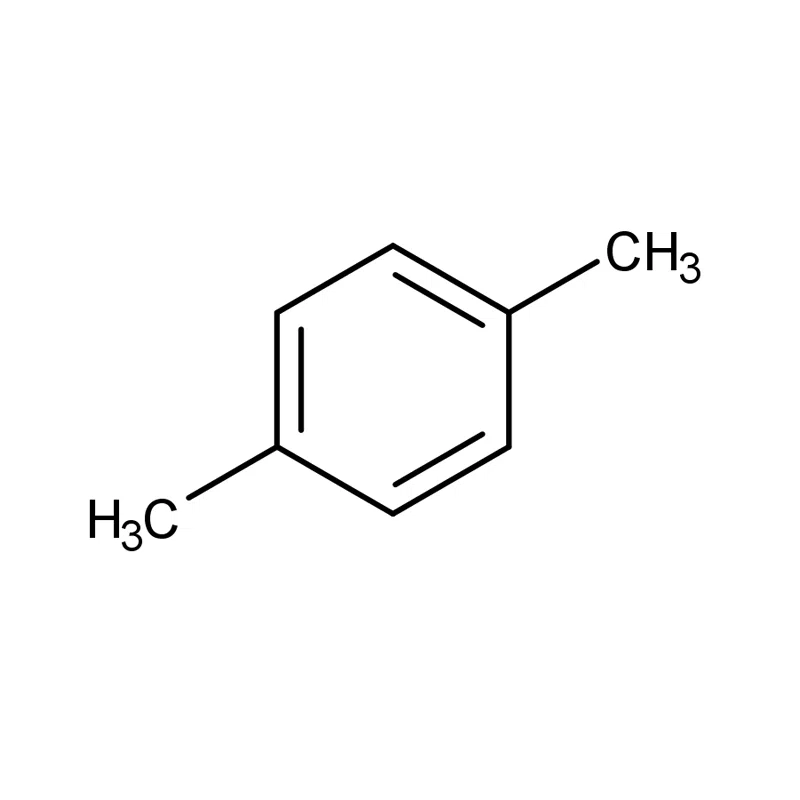
p-Xylene, also named 1,4-Dimethylbenzene, is an aromatic hydrocarbon with the molecular formula C₈H₁₀. It is a colourless, transparent liquid with a characteristic aromatic odour, and is one of the three isomers of xylene. It is slightly soluble in water while fully miscible with most common organic solvents including ethanol, ether and acetone. Compared with o-xylene, it has a relatively lower boiling point and distinctive crystallization property, which supports efficient purification by crystallization and rectification.
This substance is stable under normal storage conditions and does not react readily with weak acids or alkalis. Its high purity grade serves as a core upstream aromatic raw material for the polyester industry, and its consistent isomer content is the key indicator for commercial quality evaluation.
p-Xylene Chemical Properties
| boiling point | 138 °C (lit.) |
| melting point | 12-13 °C (lit.) |
| density | 0.861 g/mL at 20 °C (lit.) |
| vapor density | 3.7 (vs air) |
| vapor pressure | 9 mmHg (20 °C) |
| form | liquid |
| color | colourless |
| autoignition temp. | 984 °F |
| expl. lim. | 1.1% ~ 7% (vol) |
| refractive index | n20/D 1.495 (lit.) |
| solubility | water: soluble 0.2 g/L |
| SMILES string | Cc1ccc(C)cc1 |
| InChI | 1S/C8H10/c1-7-3-5-8(2)6-4-7/h3-6H,1-2H3 |
| InChI key | URLKBWYHVLBVBO-UHFFFAOYSA-N |
| Flash Point (°C) | 27 °C - closed cup |
| Hazard statements | H226,H304,H312 + H332,H315,H319,H335,H412 |
| Precautionary statements | P210 - P273 - P280 - P301 + P310 - P303 + P361 + P353 - P331 |
| WGK Germany | 2 |
| Storage Class | 3 - Flammable liquids |
| PackingGroup | III |
| HS Code | 2902430000 |
Product Application of p-Xylene CAS#106-42-3
p-Xylene is the most commercially valuable xylene isomer, mainly used as the primary feedstock for purified terephthalic acid (PTA) and dimethyl terephthalate (DMT). These two intermediates are further polymerized to produce PET resin, polyester staple fibre, polyester filament and PET packaging materials such as plastic bottles and film.
Beyond the polyester sector, it acts as a raw material for synthesizing fine chemical products including para-toluic acid, 2,5-dimethylterephthalic acid and special dyes. It can also be used as a high-performance solvent in ink, coating and adhesive formulations, suitable for systems requiring slow evaporation and good solvency for resins. In addition, it is applied in the manufacture of pharmaceutical intermediates and organic synthetic additives. Due to its dominant role in polyester chains, it is a foundational chemical for textile, packaging and plastic industries globally.